Union to open until 3 AM on weekend nights

This article first appeared on DUSA Media.

Starting this weekend, the Union is pushing back its closing time from 2.30 AM to 3 AM on Fridays and Saturdays. The change comes after Dundee’s licensing board passed new rules last week. Under the new policy, pubs can stay open until 1 AM, so-called “hybrid pubs” with “substantial entertainment” such as “Duke’s Corner” until 2 AM, and dedicated nightclubs until 3 AM on Friday and Saturday nights.

DUSA’s general manager Chris Sloan, a non-elected full-time staff member of the association, explained that DUSA didn’t favour the change. But other venues moved to extend their hours in reaction to the casino on Marketgait that is open all night and has become a popular student hangout in the early morning hours. The Union felt it needed to follow or “students will vote with their feet,” Mr Sloan said.

He explained that students now come to the Union much later than they used to, with attendance peaking around 1 AM most nights. For DUSA, which makes 90 percent of its income from “mutual trading” such as selling food and drinks, that means the “window of opportunity” for sales has shifted significantly.

The licensing board’s changes, however marginal they may seem – especially to international students from countries where no such limits exist – have been controversial. Opponents argued that Dundonians had a “toxic relationship with alcohol” and that “[a]lcohol and drug abuse blight the lives of citizens” in the city, according to the Courier.

It is questionable whether the Union’s extended hours will have a strong impact on the amount of alcohol students consume, though. “Predrinking,” the practice of meeting up before going out to consume cheap alcohol bought in stores, has become essentially universal among students.

Disclosure: As you know, DUSA Media is part of DUSA. As such, we agreed to hold this story until after the Union’s student staff had been told about the change.

School of Nursing election result to be investigated

The Election Liaison Committee, the body overseeing the Student Representative Council elections, will investigate the school president election in the School of Nursing and Midwifery. According to the final vote count, there was one vote for Re-opening nominations and none for the only candidate, Ashleigh Cooke.

“Due to the unusual nature of the result in the School of Nursing and Midwifery, the issue will be investigated by the ELC. We already have a meeting scheduled on Monday and this will be added as a priority item to the agenda,” DUSA president Iain MacKinnon said on election night.

DUSA Media has asked Ashleigh Cooke for comment but didn’t immediately hear back. We’ll update this item once she gets back to us.

Update: In an email to DUSA Media, Ashley said: “[M]y friends tried to vote for me but were unable to vote. [The system] kept saying that the page was unavailable to them.”

DUSA Media is part of DUSA. But you already knew that.

Explainer: All about the SRC

Never heard of the SRC? No idea what it does? You’re far from alone. As campaigning and voting for this year’s SRC are underway this week, our brief explainer answers the most pressing questions about what the SRC does, why it matters and what all those fancy titles mean.

Stupid question: What is the SRC?

Not stupid at all! Even students who’ve been here for years don’t really know all that much about the SRC.

Let’s start with the obvious: SRC stands for Student Representative Council and it’s a key pillar of student representation on campus.

And what does it do?

It represents all students on campus, lobbies the University, and holds DUSA and its executive accountable.

Sounds pretty vague, to be honest.

Yeah, I see your point, so let’s look at some of the stuff the SRC did last year.

For example, its members pushed the University to make reading lists available at least two weeks before the semester starts. That’ll allow students to buy cheaper books that might take longer to be delivered.

And we can get a head start on our reading for the semester!

Yeah, but who do you think you’re kidding?

If you enjoy the free WiFi in halls, that also started with the SRC. Can you imagine previous generations of halls residents had to put up with cables or buy a router on their own? Yes, first-world problems, but still awful.

Last year’s SRC also encouraged the library to provide more power sockets for charging laptops, pushed for an earlier release of exam dates so students can get cheaper tickets for going home, and passed a resolution supporting the living wage for all University employees.

Sounds pretty relevant, no?

It does, but how come I never heard about any of that?

The SRC usually has to rely on others to make changes. It can’t force the library to open earlier on weekends, for example – councillors can only lobby for it. Same with DUSA, where policies are set by the board.

Both the university and DUSA’s executive pay attention to the SRC, though, so it has become a real voice for students.

So who is on the SRC?

There are 50 people from all walks of university life, as the cliché goes. You can’t vote for all of them this week – some are there because of other positions they hold – but most will need your support.

Let’s start with the elected positions. I’ll try to keep it short, promise.

  • The SRC Chairperson is the official head of the SRC, chairs its meeting and sets its agenda.
  • The Learning and Teaching Rep deals with learning and teaching matters (duh) and feeds student comments back to the University. There are also a 1st Year Learning and Teaching Rep, a Postgraduate Rep for Learning and Teaching, and an International Students Rep for Learning and Teaching to focus on issues particularly relevant to these groups.
  • The Services and Facilities Rep handles matters relating to DUSA and University services and facilities (like the library or eVision). There are also a 1st Year Services and Facilities Rep, aPostgrad Services and Facilities Rep, and an International Students Rep for Services and Facilities.
  • The Environment and Sustainability Rep works with DUSA and the University for a greener campus. He or she is also actively involved with DUSA’s commitment to Fair Trade, so you can drink your coffee knowing it wasn’t picked by Guatemalan kids who are paid a penny a day.
  • The Equality and Welfare Rep deals with equality and diversity on campus. If you’re straight or LGBT, a man or a woman, tall or small, or individual in any other way, shape or form (that’s everyone), he or she helps create a discrimination-free environment for you.
  • The Disabilities Rep handles disability provision concerns. A huge part of his or her job is to ensure that students with disabilities have as good a time at university as everyone else, from easy access to lecture theatres to fun nights out.
  • There are three SRC Councillors without Portfolio who deal with questions not covered by the other Reps. So if you have an issue but don’t know who to talk to, these are the people to bother!
  • It’s sometimes easy to forget that not all students are in their late teens or early twenties. That’s where the Mature Students Rep comes in. He or she works on matters that are particularly relevant to students with more life experience than the average halls resident.
  • Students of every school also elect a school president who gets to sit on the SRC.

Ummm… What school am I even in?

No idea. If you don’t know, check your student profile on eVision.

You mentioned other non-elected SRC members.

Well, most of them actually are elected, just in different ways. Members of DUSA’s Societies Council send two Reps, a Student Staff Rep represents DUSA’s student employees, there’s a Halls Rep for students living in University accommodation, and DUSA’s media outlets (of which we are one) select a Media Rep. The Sports Union, DUSA’s exec and the rector are also represented.

All these guys are campaigning on campus and it’s super annoying. Why can’t they leave me alone?

Are you one of those who never run or vote for anything and then loudly complain about everything? No? Then don’t be such a grump, man. Get some candy, enjoy democracy in action, and see which candidates offer more than a boilerplate “I want to improve your student experience.”

Okay, I’m pumped to vote now! How and when can I do that?

Awesome! Voting starts Thursday at 9 AM on MyDundee and closes Friday at 5 PM. The candidates will probably make sure you don’t forget, though.

Standard disclosure: DUSA Media is part of DUSA. But you already knew that.

One year before indyref, Scottish parties to debate education at Dundee Uni

This article first appeared on DUSA Media.

Exactly one year before the Scottish independence referendum, representatives of all parties in the Scottish Parliament will debate the implications for education in Scotland at Dundee University next week.

Students will have the chance to ask questions they have about the possible consequences of independence on their education. “It must be highlighted that this issue is not limited to Scottish nationals but is something which should be considered by our RUK, EU and international students,” said Zuchaela Smylie, DUSA’s Vice President of Communications and Campaigns.

Journalist David Torrance, also the associate director of the University’s “5 Million Questions” initiative, will chair the event. According to Mr Torrance, questions that will be discussed include, “Would independence improve the quality of Scotland’s schools? Would independence help or hinder attempts to tackle educational inequality? And when it comes to higher education, what would independence mean for university admissions and research funding, both currently handled on a UK-wide basis?”

A University press release stated that “5 Million Questions” attempts to overcome the “overtly party political” nature of the Scottish independence debate so far.

On the panel for the “Big Education Debate” will be the Scottish education secretary, Michael Russell (SNP), MSPs Neil Bibby (Labour), Liz Smith (Conservative) and Liam McArthur (Liberal Democrats), and Pauline Hinchion, co-convener of the Dundee Green Party. University principal Pete Downes will also be participating.

The event starts Wednesday, 18th September, at 7:30 PM in the Dalhousie Building. You can get free tickets here.

Standard disclosure: DUSA Media is part of DUSA. But you already knew that.

DUSA tops Scottish students union ranking

This article first appeared on DUSA Media.

Dundee University Students’ Association (DUSA) was once again rated Scotland’s best student union in the latest National Student Survey (NSS). One of the 10 best student associations in the UK, DUSA placed far ahead of other Scottish student unions.

DUSA’s new president Iain MacKinnon welcomed the news in a statement: “A lot of people might see student unions as solely a place for students to enjoy their evenings whilst at university, but here in DUSA we offer so much more.” MacKinnon highlighted DUSA’s support and funding for more than 100 student societies on campus, the association’s various welfare campaigns, and the work of DUSA’s media outlets.

In the NSS university ranking, the University of Dundee achieved 88% satisfaction, down two points from last year. Among all Scottish universities, Dundee came in fourth, after tying for second place in 2012. The University of St. Andrews topped Scottish institutions with 93% student satisfaction. Students at the University of Bath were the most satisfied in the UK with 94%.

Full disclosure: DUSAmedia.com is part of DUSA. But you already knew that.

Defending rapists isn’t immoral

This article first appeared on DUSA Media.

In a long piece over at the University of Birmingham’s “Redbrick”, Laura Brindley describes this theoretical scenario:

A fourteen year old girl has been violently gang raped by five men, in littered woods, just ten minutes away from where the girl lives in her council flat with her single mother and four siblings. On a humid summer night, a girl drunk with cheap vodka the men had bought her loses her childhood … [T]he girl has a “bad girl” reputation in school.

The defense uses the girl’s reputation against her in court, and her rapists go free.

In her headline, Laura asks whether you can morally defend a rapist. She argues that defense lawyers “who know deep down that their client is guilty of rape (whether the client had said the words out loud or not)” should “put forward the truth whether it loses them their case or not.” I think it’s the wrong question to ask, and the way she goes about answering it misunderstands both the job of the justice system and role of the various parties in it.

In Laura’s scenario, there’s no question that the girl was raped. In real life, however, this case would start with a claim by a girl, and whether or not her story is true needs to be investigated. When Philip Rumney reviewed studies on the subject in 2006, he found that false reporting rate estimates ranged from 1.5 percent to 90 percent (ungated copy here). Recent estimates tend to be on the lower end. A March 2013 report by the Crown Prosecution Service, for example, said that between January 2011 and May 2012, there were 5,651 prosecutions for rape in England and Wales, compared to 35 prosecutions for making false allegations to that effect. (That number doesn’t include withdrawn allegations.)

Let’s be clear: False rape allegations are rare. But that doesn’t mean that the number of allegations automatically equals the number of crimes. (Unfortunately, that’s true both ways: Too many rapes aren’t reported because many victim are too afraid or too ashamed.) And given that it’s almost impossible to navigate the spider web of laws and precedents without expert help, defendants only have a chance to prove their innocence with the help of a lawyer.

In a trial, there are three parties, and each has a distinct role. Put simply, the prosecution assumes the very worst about the defendant and presents the evidence that backs up its case. The defense assumes the very worst about the victim and presents the evidence that backs up its case (or plays devil’s advocate and attempts to weaken the prosecution’s version of events). Judges and juries look at the evidence and have to figure out which side’s version is closer to the truth. This process often results in verdicts that the public finds frustrating or disappointing.

An emotional response to some verdicts isn’t a good reason to abandon a pretty well tested system, though. Each side deserves to be heard and has the right to question the other side’s version of events. Again, only in the scenario can we know for sure that the rape happened; in real life, we’d probably have two conflicting versions of what happened, and at least initially no way of knowing for sure which one is true.

Laura’s alternative would seriously undermine that balance. Let me quote her again, because I don’t want to mischaracterize her position (emphasis mine):

The problem are defence lawyers who know deep down that their client is guilty of rape (whether the client had said the words out loud or not) … We need more defence lawyers who are prepared to find out the real story from their client and put forward the truth whether it loses them their case or not.

According to Laura, it doesn’t require the defendant’s admission for the defense to effectively switch sides. I assume that by “deep down”, Laura actually means “after careful examination of the available evidence;” everything else would be fairly indefensible. But every trial already has a party whose job it is to weigh the evidence and attempt to reach a verdict informed by the facts: judges and juries. They determine whose version is more credible after both sides get to question each other’s stories, but for that they need to hear both sides. They’d only get to hear one if defense lawyers followed Laura’s suggestion.

There certainly are defense teams who aggressively portray their opponents as unreliable. But experience tells us that in Laura’s scenario, the prosecution would probably try the same. What if one of the alleged rapists had been accused of domestic violence by an angry ex-wife in the past, even if the case was dismissed? Or another had been a former alcoholic who had been unemployed for years and was suffering from depression as a result? It doesn’t take much imagination to see these circumstances being brought up by the prosecution (or being leaked to willing “journalists” eager for a “scoop”). It’s a dirty game both sides routinely play, and the effects probably cancel each other out.

The question is not whether it’s immoral to defend a rapist, but for the record, it’s not. In our judicial system, loyal and competent defense lawyers are a prerequisite for a fair trial. In dubio pro reo and the presumption of innocence until proven guilty are two pillars of the rule of law. Both put the burden on the prosecution, and for good reasons. In some cases, that may result in an acquittal because there isn’t enough evidence for the prosecution to prove their case.

On a personal level, that may be tragic. But for a society, having some who are guilty go free is a smaller price to pay than putting many who are innocent behind bars.

Lots of fire alarms, but few fires in Dundee halls

This article first appeared on DUSA Media.

For halls residents, fire alarms are a near daily occurrence. But when firefighters show up, they rarely find a fire.

A group of people, some of them still in their PJs, standing outside in the rain, while a beeping sound cuts through the silence… If you’ve ever lived in one of Dundee University’s residences, you know what that means: A fire alarm went off somewhere in the building. It has become something of an initiation ritual for students living in halls, and talking about it is a sure-fire way to start a conversation that everyone on campus can join.

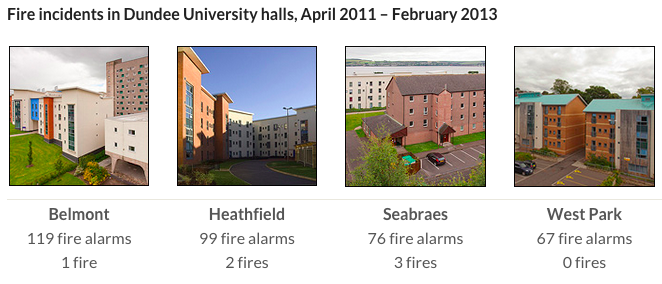
According to numbers obtained from Tayside Fire and Rescue through a Freedom of Information request, fire alarms in student accommodation in Dundee went off 546 times between 1 April 2011 and 5 February 2013.

Dundee University fire alarms

Take a guess: How often did firefighters have to deal with, you know, actual fires?

If you came up with an estimate in the double digits or more, you’re way off. The fire brigade extinguished flames exactly nine times in almost two years. Apparently, kitchens are a particularly dangerous place. Three “pots of meat”, a frying pan on a hob, two towels and two paper bins caused fires. There also was an unspecified incident in a kitchen.

More than 98 percent of fire alarms that went off in student accommodation did so for other reasons. The main causes, a spokeswoman for Tayside Fire and Rescue dryly notes, included “cooking, deodorant spray, straighteners, candles, showers, etc.” A West Park resident tells a story that will be familiar to many: “Following a night that involved drinking out of a shoe, several air-soft gun rampages and much profuse vomiting, some pillock decided it would be a good idea to set off our fire extinguisher. Aside from suffocating the entire population of our hallway, it rather ironically also set off the fire alarm.”

Residents in Dundee University’s halls are particularly likely to set off fire alarms for no (fire-related) reason. The highest number of alarms – 119 – came from Heathfield. The leader in actual fires, however, is Seabraes: Out of 76 alarms, three incidents there required firefighters.

It probably will not surprise you that anecdotal evidence suggests alcohol often plays a role in fire alarms, like in this story told by a former Belmont resident: “When we came back from Skint, my flatmate tried to make chips. A huge gust of smoke came out when she opened the oven, and the fire alarm went off. The fire brigade discovered that someone had tried to cook a shoe in our oven. Our entire flat was deemed toxic because of the fumes from the plastic.” (The incident took place in 2010 and isn’t included in the figures above.)

How do other student residences in the city stack up? Well, it isn’t even close. Over 22 months, fire alarms went off in The Hub just four times, and not once in The Opal, according to Tayside Fire and Rescue.

Asked whether students are too careless when it comes to setting off fire alarms, Tayside Fire and Rescue preferred to “not give an opinion.”

In all fairness, the numbers probably speak for themselves.


Dundee University’s halls are the most expensive in Scotland

This article first appeared on DUSA Media.

Students living in university accommodation at the University of Dundee pay significantly more than their peers anywhere else in Scotland. DUSA’s president says it’s time for a rent freeze.

About 1,500 students live in one of the University’s four halls. Two residences, Belmont and Heathfield, are located on campus, and a third one, Seabraes, is a five-minute walk from the University. For 2013-14, students living there will be paying £4,865 per year. Rents are lower for residents of West Park, where rooms cost almost £4,200 – at the price of being two kilometres (1.2 miles) away from The Union and other campus facilities. These rates get tenants an en-suite single bedroom with about 13 square metres. Two more square metres will set them back an additional £140 per year.
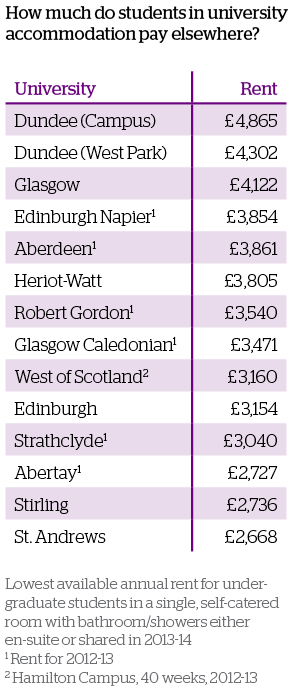
Scottish-universities-accommodation-pricesNo other University in Scotland charges more than Dundee for a self-catered single room. Rents in University residences in Edinburgh and Glasgow are significantly lower, despite higher average rents for one-bedroom properties in both cities. Even in “posh” St. Andrews, students who are fine with walking 15 minutes to the city centre can live in much more affordable accommodation.

Rents in Dundee University’s halls have risen dramatically since 2009. In 2009-10, hall residents paid about £4,100 for a standard room. Three years later, annual rents have gone up by £750, an increase of more than 18 percent.

In the same time period, monthly prices for other one-bedroom properties in Dundee have remained virtually unchanged, according to Rentright, a company that provides information on average prices of rental properties. Across all types of leased housing in Dundee, prices have fallen in the three years since September 2009.

The Residences Office claims that student accommodation at the University of Dundee was in a pitiful state before 2004. “In order to bring it up to modern standards expected of our students and of legislation, over £40 million was borrowed and invested through a joint partnership agreement” with Sanctuary Housing Association and the Bank of Scotland. Annual rent increases are negotiated and agreed to by the University under a process in which DUSA, the student association that also publishes this magazine, is consulted – or so the Residences Office claims.The University of Dundee’s Residences Office cautions against comparing rents among Scottish universities because of varying lease lengths and facility standards. There’s indeed one major difference: In Dundee’s halls, every room comes with an en-suite bathroom and shower, whereas most other Scottish students pay extra for these conveniences. Leases for undergraduate students, however, generally last around 39 weeks to cover the academic year. Other differences are marginal.

That’s an “inaccurate statement,” says Iain Kennedy, DUSA’s president. “A DUSA [representative] sits on a liaison committee, alongside staff from the University and Sanctuary Management, however this group does not have any control over financial issues.” Kennedy also said that DUSA has expressed concerns over rent increases in the past, but to no avail, because of the partnership agreement’s “financial process which ensures that the rent increases every year.”

Dundee-university-accommodation-rent-increases

The joint venture has been a double-edged sword for the University. In April 2007, some members of the University’s administrative governing body, the University Court, “felt that the current prices were uncompetitive,” according to meeting minutes. They urged the joint venture “to be cautious in setting prices [and] consider more innovative marketing ideas.”

A 2008 study by the University and Colleges Union (UCU) found that the University had incurred massive losses from the partnership. “Halls in the new student [residences] remain empty while the venture made losses of £500,000 [in 2007] and a staggering £1.3 million [in 2008]. The University’s share of this is £400,000 and the proportion appears to be rising,” according to the study. UNISON, a public sector trade union, noted in a PowerPoint presentation that the “University has had to provide funding to the company from its own revenues.”

Things have changed, apparently. The Residences Office claims that the occupation rate in halls now is “around 99 percent.” According to court minutes for April 2011, that is higher than projected. Yet the minutes also record that “for 2011-12, residence fees would be increased by 5.54 percent.” In other words, the residences are making more money than expected, but rents keep rising.

Living on campus has an obvious appeal, particularly for first-year students. “It’s convenient, first years have a guaranteed place, and it’s a great environment to meet new people,” says David, a Heathfield resident who started university last September. I asked him whether he felt that en-suite bathrooms and showers were necessary, given that most students share these facilities with flatmates once they move into private accommodation. He paused for a moment before saying, “well, it’s too expensive for my liking – but I guess it’s a nice little luxury.”

That little luxury comes with a price tag that exceeds many student loans. The maximum amount paid out by the Student Awards Agency for Scotland (SAAS) currently is £5,570, but most students get much less. The average loan paid out by SAAS in 2011-12, the most recent year for which data is available, was £4,256 – more than £200 short of the rent in campus residences at the time.

Kennedy thinks it’s time for a rent freeze. “I believe we are now getting to a point where further rent increases are unsustainable. It’s my hope that the University, in conjunction with other partners in the [joint venture], will seek a review of the terms which determine annual rent increases.”

That’s unlikely to happen. The University cites a Residences Office survey in which nine out of ten first-year residents said that they “would recommend living in university residences to prospective first year students.” The University also points to the results of the most recent Times Higher Education Experience Survey which found that most Scottish students are less satisfied with their university accommodation than their peers in the rest of Britain. (North of the border, students at the University of West Scotland were unhappiest: UWS placed 106 out of 107 in the accommodation ranking.) The Residences Office proudly notes that in the study, “Dundee University was voted joint second for ‘Good Accommodation’ in the UK.”

But at almost five grand a year, there’s no reason why students should settle for anything less.

Why is the WiFi in the library so slow?

This post first appeared on DUSA Media.

One thing many students definitely remember from revising in the library is their browser’s error page.

WiFi connections in the library have either been non-existent or frustratingly slow for months now. Surprisingly, the University’s Information and Communication Services (ICS) directorate wasn’t aware that there was a problem in the first place until mid-March. In an email statement, ICS assistant director Ellen Keir said that “prior to that we had nothing significant reported either directly to Service Desk in the library or through our online tool for reporting issues, Help4U.”

The problem, according to Keir, was that bandwidth use in the library was well within acceptable limits – but the number of connections exceeded capacity. Attempts to fix the issue during the Easter break were prevented by delays in getting parts from a supplier. Remedial work has been completed since and ICS says this should have solved the problem.

On top of that, says Keir, ICS became aware of a separate capacity issue on the library’s ground floor, caused in part by additional study spaces set up during the exam period. ICS testing shows that Internet access there seems to work fine now.

Keir encouraged students to report any problems with Internet access on campus to the Service Desk in the library or online. “Our systems monitoring can only do so much and is often focused on availability,” she said. Last time, ICS became only aware of problems with WiFi access when Keir attended a Student Representative Council (SRC) meeting in March, after which the department started investigating the issues. Says Keir, “without feedback from students we may be unaware of their difficulties.”

Still having problems with WiFi in the library? Let us know in the comments and report them to Help4U.